
Members of the Monetary Policy Committee (MPC) felt that though the Indian economy was resilient in the third wave, it, however, lost some momentum and with inflation likely to soften, there is room to continue with the accommodative stance and support revival, the minutes of the MPC meeting released on Thursday revealed. The six-member MPC voted to keep the policy rate unchanged and continued with the accommodative stance at its meeting on February 10. However, external member Jayanth Verma voted against the stance because he felt a switch to neutral was long overdue and the current stance has become counterproductive and deflects focus away from addressing recessionary trends that date back to at least 2019.
Finance Minister Nirmala Sitharaman will present the much-awaited 2022-23 Union Budget on February 1. While there has been strong recovery in some sectors, touch services like hospitality, tourism and leisure continue to suffer after two Covid-19 waves. Household savings have been hit due to increased spending on health care. Consumption has still not reached pre-pandemic levels.
It is now becoming increasingly clear that rising imports have played a significant role in sustaining the buoyancy in revenues from GST, notes A K Bhattacharya.

'The road ahead for the government's fiscal management will be full of many new challenges,' warns A K Bhattacharya.
India is better positioned to face external shocks emanating from increasing geopolitical tensions, the aftermath of the COVID pandemic and the inevitability of climate change, Reserve Bank Deputy Governor Michael Debabrata Patra said on Monday. Relative to macroeconomic configurations in 2013 when India was described as one of the fragile five countries, he said, "India is better positioned currently, as its macroeconomic fundamentals have improved significantly, and external sector indicators point to the availability of enough cushions to manage external shocks." He was speaking at a conference on 'Growth And Development in the BRICS Economies' organised by the Delhi School of Economics (DSE) and the Indian Statistical Institute (ISI).

'In a serious fiscal situation like this, an ostrich-like focus on annual budgeting, event management and defensive rhetoric will only make matters worse,' warns Rathin Roy.
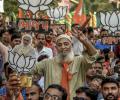
The Centre for Media Studies after releasing a report on 2019 polls expenditure, also claimed the recently-concluded election has signalled that the more the expenditure, the "more vicious and ugly" the campaigns become.

At Rediff Labs, we analysed the data on military expenditure by Stockholm International Peace Research Institute.
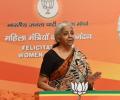
Nirmala Sitharaman is proving to be a better finance minister than her initial rookie status might have led people to expect, observes T N Ninan.

'India seems to be on a relatively better wicket compared to other emerging markets.'

Never before in post-reforms India have Union Budgets seen a steady reduction in fiscal deficit for five consecutive years, points out A K Bhattacharya.

The finance minister could well be on her way to setting a record of achieving the biggest single-year reduction in the government's fiscal deficit, explains A K Bhattacharya.

Finance Minister Nirmala Sitharaman on Wednesday raised the personal income tax rebate limit, doled out sops on small savings and announced one of the biggest hikes in capital spending in the past decade as she did a tight rope walk in the Budget between staying fiscally prudent and meeting public expectations in the year before general elections.

The demand for black oils and specialty products like fuel oil, bitumen, petcoke and sulphur has also shown marked improvement, facilitating increase of refineries throughput.

From the enactment of the capital control Act to the recognition of the BSE as a stock exchange and the infamous Harshad Mehta scam, here are the 18 biggest events for stock markets from 1947 to 1993.

The government will set up 16 new medical colleges over the next five years.
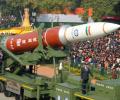
'The government must provide more funds to enable the armed forces to fight and win tomorrow's wars,' states Brigadier Gurmeet Kanwal (retd).

Tuesday's bridge collapse once again puts the spotlight on the city's urban infrastructure and a dire need for its development.

'The Budget will have to be substantially re-cast as soon as a new government takes charge after the elections.' 'Both revenue and expenditure numbers will have to be trimmed -- and then may better reflect the deceleration of economic activity caused by slowing consumption trends,' points out T N Ninan.

It was 55.3 per cent for the same period last year, and data shows the fiscal deficit for April-May was kept in reasonable check in spite of heavy frontloading of expenditure.

Experts said a dip in consumption expenditure indicated an increasing prevalence of poverty in the country.

Hit by the third wave of the COVID-19 pandemic and soaring fuel prices, airlines are flying towards record losses with a likely loss of a whopping Rs 20,000 crore for the full fiscal year, warns a report. The airlines are flying towards their steepest-ever net loss of over Rs 20,000 crore this fiscal, which will be 44 per cent more than Rs 13,853 crore they bled last fiscal, Crisil said in a report. This will push back the industry's recovery beyond fiscal 2023, the report based on three large listed airlines--Indigo, Spicejet, and Air India--which together command 75 per cent of the domestic traffic, warned.

Digital canvassing is expected to benefit from political money looking for alternative blow horns.

The Indian economy has recovered 'handsomely' from the pandemic-induced disruptions, former Niti Aayog vice chairman Arvind Panagariya said on Tuesday, while expressing hope that the recovery will be sustained and the growth rate of 7 to 8 per cent will be restored. Panagariya suggested that the government must now signal its intention to wind down fiscal deficit by cutting it by half-to-one percentage point in 2022-23. "The Indian economy has recovered handsomely, returning to its pre-COVID GDP... "Only private consumption is still below its pre-COVID-19 level," the eminent economist told PTI in an interview.

Only Hindustan Unilever and Nestl bucked the trend.

While the five years of the Modi government have indeed seen a healthy increase in PSUs' outlay and the Budgetary support for them, the next year's numbers reveal the squeeze in the government's own resources even though it is expecting a much higher dividend income from the PSUs. These do not augur well for the PSUs in 2019-20 and the years ahead, unless these numbers are revisited and, hopefully, revised in the full Budget that will be presented later in July this year, says A K Bhattacharya.

When Finance Minister Nirmala Sitharaman tables her Budget on February 1, the numbers could be something to cheer.
The preliminary processing of tax returns is already undertaken with the help of technology. There is now greater scope of using more technology to reduce the human interface even further, notes A K Bhattacharya.

The growth in the contact-intensive portion of the economy trailed our expectation, highlighting how imperative it is for confidence to improve, either through accelerated vaccinations or otherwise, to drive a sustainable recovery in these sectors, asserts Aditi Nayar.

India spent USD 63.9 billion on its military in 2017, an increase of 5.5 per cent compared with 2016 and of 45 per cent since 2008.

In 10 years from 1995 to 2005, the military expenditure in South Asia increased by 50 per cent, and one in every 10 military personnel in the world are in this part of the globe, a United States report has said.

Experts attribute this trend to a combination of end of capital expenditure cycle, increased automation, RIL's preference for time-bound labour contracts, and telecom and retail's outsourced human resource model.

India's harsh lockdown has left companies grappling with temporary closure, chaotic supply chains and depressed demand. Consequently, business plans have been modified.
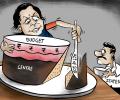
Every option before the finance minister comes with a price tag, observes T N Ninan.
Almost 63 per cent of the increased allocation of around Rs 1.01 trillion has been spent in the first five months of 2020-21.
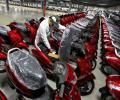
Retail sales of cars are back to January 2018 levels in August 2021. Two-wheeler retail sales are 22 per cent lower, nearly four years down the line.

India's Rs 4.5-trillion fast-moving consumer goods (FMCG) sector was one of the first to bounce back from the lockdown induced blues, reporting a year-on-year (YoY) growth in the October-December quarter last year. That said, the overall consumption figures continue to remain depressed. The FMCG market, which includes daily consumables like branded atta, hand sanitizers, edible oils, shampoos, razors, and so on, recorded 7.3 per cent value growth during the period, while the smartphone market grew by 21 per cent.

Despite unprecedented levels of uncertainty in Samvat 2077, investors have little to complain about on the returns front. The BSE Sensex delivered returns of 38 per cent in this period, while the Nifty registered a return of over 40 per cent. As is the case in bull markets, companies in the small- and mid-capitalisation basket outperformed the benchmarks, with returns almost twice those of frontliners.
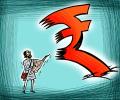
Historically, there has been no correlation between growth in bank credit to industry and lower benchmark interest rate

Finance Minister Nirmala Sitharaman on Thursday said the Indian economy is witnessing a strong recovery after a long and strict lockdown. Addressing a press conference to announce more stimulus measures to boost growth, she said macro-economic indicators are pointing towards recovery. She noted that COVID-19 active cases have declined from over 10 lakh to 4.89 lakh with case fatality rate (CFR) at 1.47 per cent.
